Property fit
We check the asset type, location, condition, marketability, occupancy, and any title or zoning issues that may affect lender interest.

Private mortgage lenders in BC can help when a bank or credit union cannot approve the file under standard rules. The loan is secured by real estate, and the review often gives more weight to property value, equity, location, and the exit plan.
Seven Lending acts as a licensed mortgage brokerage. We review your needs, compare suitable private lenders, explain the first- or second-mortgage structure, and show the costs before you choose an option.
A private mortgage is usually a short-term tool. It should solve a clear problem and lead to a practical next step, such as a bank refinance, a B-lender mortgage, a property sale, or repayment from confirmed funds.
A private mortgage is a loan secured against real estate and funded outside the usual bank channel. It may come from an individual investor, a mortgage investment corporation, a private fund, or another alternative lending source.
A mortgage broker is not automatically the lender. The broker gathers the file, checks the property and mortgage details, compares lender criteria, and presents suitable options. The lender makes the final approval decision and provides the funds.
Private lenders do not all use the same rules. One lender may prefer urban houses under a lower LTV, while another may consider a rental property, mixed-use building, construction file, or rural asset.
Our role is to match the loan purpose, property type, amount, mortgage position, and exit plan with a lender that is prepared to review that exact situation.
Borrowers who are new to this market can also review what a private mortgage lender is and how private-lender safety is assessed.

These financing categories remain available for borrowers, homeowners, investors, and business property owners across British Columbia.
Residential and home-equity files usually focus on appraised value, existing mortgages, and the amount of usable equity. Commercial, construction, and investment files may also require rent, project budgets, zoning, permits, or a business plan.
A no-income-verification or bad-credit file still needs a workable property, acceptable LTV, and a realistic way to repay the loan. A private lender does not ignore risk; the lender reviews it differently.
The lowest advertised rate is not always the best fit. A useful lender match must work for the property, timeline, repayment plan, and total cost.
We check the asset type, location, condition, marketability, occupancy, and any title or zoning issues that may affect lender interest.
The lender needs to know whether the loan will be registered in first or second position and how much secured debt will remain ahead of it.
A purchase, refinance, tax payout, renovation, bridge, or debt-consolidation file may call for different terms and documents.
We look at how and when the balance is expected to be repaid, including a backup plan if the first exit takes longer than expected.
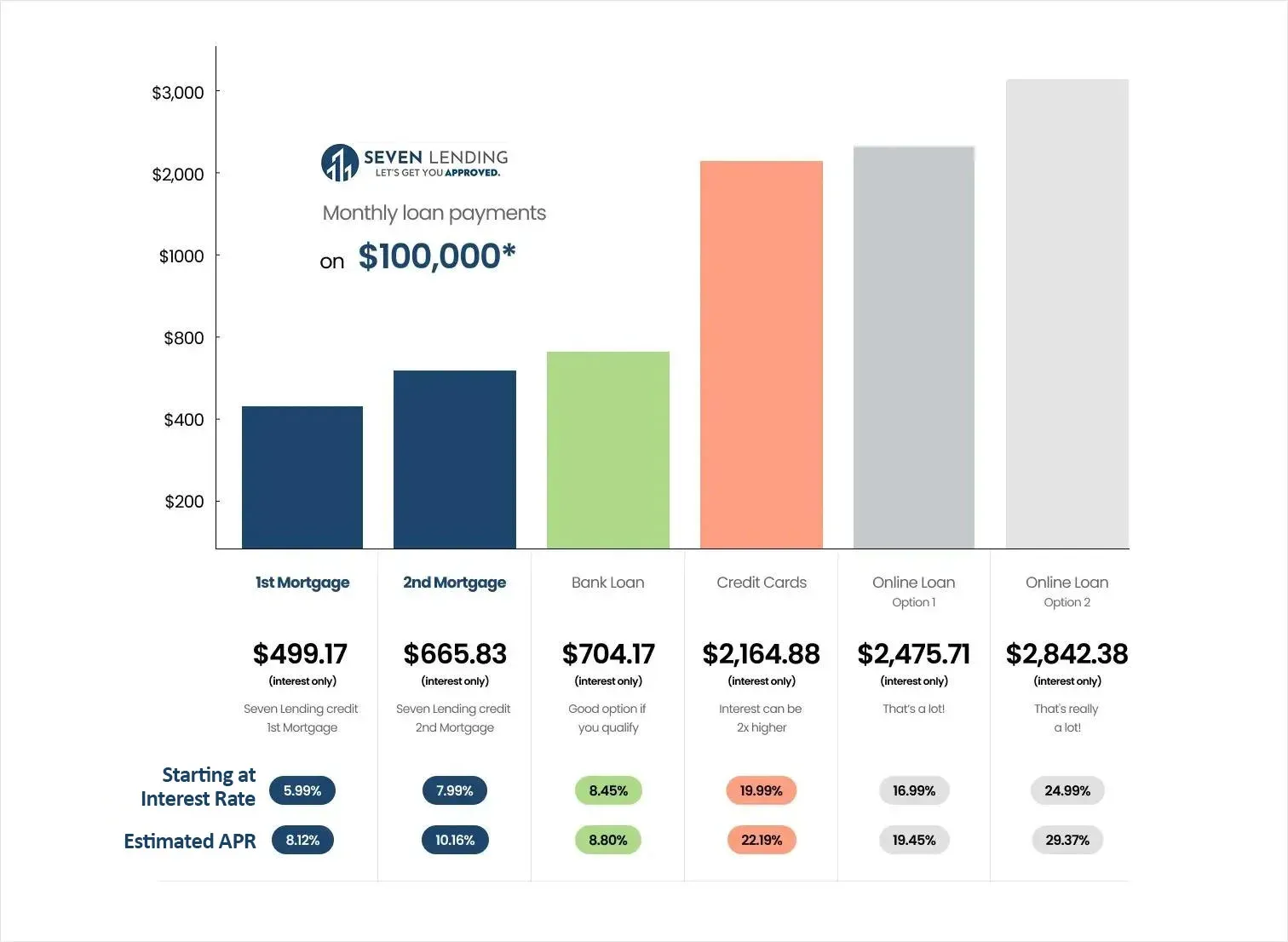
Private mortgage pricing depends on risk, LTV, mortgage position, property type, location, term, and the strength of the exit plan. The image below is an illustration, not a guaranteed quote.
*Interest rates are compounded monthly, not in advance.
*All content is subject to change without notice.
* Terms and conditions apply.
* Final approval is at the sole discretion of the lending committee.
*The APR mentioned here is higher than the rate because it assumes additional costs including lender fee, broker fees and legal fee plus other costs not limited to title insurance, appraisal costs etc. for a 1st or 2nd mortgage offered by Seven Lending.
*Numbers are estimate only and provided to show an illustration, for up-to-date numbers and exact APR please refer to Fixed Credit Disclosures of the offering or contact a licensed agent with Seven Lending.
Rates and APR can change. The APR may include lender, brokerage, legal, appraisal, title, and other transaction costs. Review current details on the private mortgage rates page.
The mortgage position changes the lender's risk, the available loan amount, and the cost of the financing.
A first mortgage is registered ahead of other mortgages. It may finance a purchase or replace an existing first loan through a refinance.
A second mortgage is registered behind the first lender. It can release equity without replacing a strong first-mortgage rate.
The choice should compare the full cost of keeping or replacing the existing mortgage. See second mortgage vs refinancing for a focused comparison.
Loan-to-value, or LTV, compares mortgage debt with the appraised property value. For a second mortgage, lenders usually review the combined LTV, which includes all mortgages secured on the property.
LTV = total mortgage debt ÷ appraised property value × 100
Example: A property valued at $1,000,000 with a $550,000 first mortgage and a proposed $150,000 second mortgage has a combined LTV of 70%.
A lower LTV usually means the lender has a larger equity cushion. That can improve lender choice, pricing, or terms, but no percentage guarantees approval.
The final value normally comes from an appraisal accepted by the lender. Property condition, market demand, title issues, taxes, insurance, and location can also affect the decision.

Private approval is based on the whole transaction. Equity matters, but the lender also reviews the property, loan purpose, payment plan, and exit.
| Review Area | What It Tells the Lender |
|---|---|
| Property location | How easy the property may be to value and sell if needed. |
| Property type | Whether the lender accepts residential, commercial, mixed-use, rural, or construction security. |
| Appraised value | The value used to calculate LTV and available equity. |
| Mortgage position | Whether the lender will be registered first, second, or behind other secured debt. |
| Loan purpose | Why the money is needed and whether the use supports the exit plan. |
| Exit strategy | How the lender expects the balance to be paid at or before maturity. |
The monthly payment is only one part of the decision. A clear quote should show the rate, APR, fees, legal costs, net proceeds, maturity date, and repayment conditions.
Some private mortgages allow interest-only payments during the term. This can lower the monthly payment, but the principal usually stays the same unless extra payments are permitted and made.
The full balance may still be due at maturity, so the exit cannot be left until the last month.
The transaction may include a lender fee, broker fee, appraisal, legal work, title insurance, registration, discharge fees, and a first-mortgage penalty.
Ask for the amount you will receive after deductions and the total dollar cost over the planned holding period.
The mortgage is secured by real estate. Missed payments, unpaid taxes, lapsed insurance, or failure to repay at maturity can lead to added charges and enforcement.
Borrow only when the payment and exit plan remain realistic under a delayed or more expensive scenario.

A private mortgage should be arranged around the end result. The term needs to be long enough to fix the current issue and move the file toward a lower-cost or permanent solution.
The loan may stop an urgent payout, complete a purchase, finish a project, or consolidate expensive debt.
This may involve rebuilding credit, documenting income, completing construction, resolving tax debt, or preparing a property for sale.
The planned exit may be a bank or B-lender refinance, property sale, business proceeds, estate funds, or another confirmed source.
A good private mortgage exit strategy includes timing, expected documents, a cost estimate, and a backup route.
Local market knowledge matters because property values, lender appetite, and appraisal support vary by city and property type.
Files outside these centres may still be considered. Rural, recreational, manufactured-home, land, and commercial properties need a more specific lender review.

Share the property address, estimated value, mortgage balances, amount needed, purpose, and timing.
We assess LTV, property fit, mortgage position, costs, and exit strength before approaching suitable lenders.
You review the written terms and conditions. The mortgage closes after appraisal, documents, and legal requirements are complete.





There is no single minimum used by every private lender. Some lenders consider low-credit files when the property, equity, loan purpose, and exit plan are strong. Credit can still affect price and conditions.
The amount depends on the appraised value, all secured balances, lender LTV limit, property type, location, and mortgage position. A lower combined LTV usually creates more lender choice.
Possibly. The private lender reviews the first-mortgage balance, available equity, title, payment history, loan purpose, and the combined LTV after the new second mortgage.
Some products offer interest-only payments, but this is not automatic. The commitment explains the payment structure, rate, term, prepayment rights, and amount due at maturity.
Possible costs include lender and broker fees, appraisal, legal work, title insurance, registration, discharge charges, and a penalty on the mortgage being replaced. Ask for the APR, net proceeds, and total cost.
Private terms are often shorter than standard bank terms, but the exact length depends on the lender and transaction. The term should match the time needed to complete the exit plan.
Mortgage brokering and mortgage lending activities in BC fall under provincial regulatory requirements. Borrowers should confirm who the brokerage and lender are, review disclosures, and obtain independent legal advice before closing.
Contact the broker and lender early. Possible outcomes may include an extension, renewal, refinance, sale, or repayment from another source, but no option is guaranteed and extra costs may apply.


Start with the property address, estimated value, current mortgage balances, amount needed, and reason for the loan. We will review the likely mortgage position, LTV, lender fit, costs, and exit plan.
Approval is not guaranteed, and private financing is not the right choice for every borrower. A clear comparison can show whether the loan solves the problem at an acceptable total cost.